
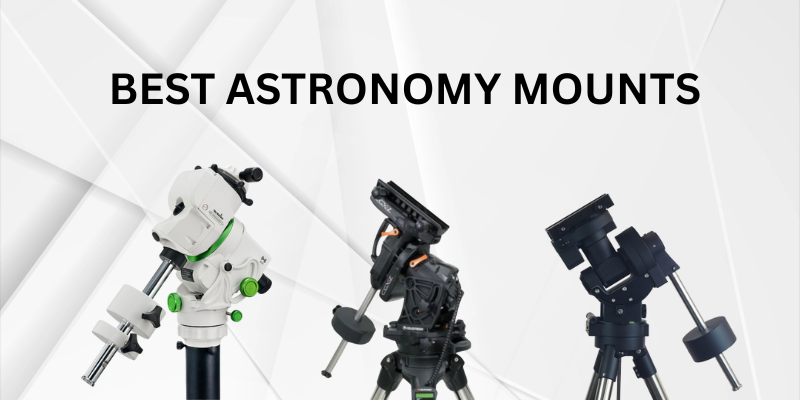
In astrophotography, your mount is just as important as your telescope or camera. It’s the part that keeps your equipment perfectly aligned with the stars, compensating for Earth’s rotation to deliver sharp, pinpoint images. A poor-quality mount can ruin long-exposure shots – even with the best optics.
Whether you’re capturing galaxies, nebulae, or the Milky Way, choosing the best astrophotography mount will determine how crisp and steady your results appear.
Types of Astrophotography Mounts
Equatorial Mounts (EQ Mounts)
Equatorial mounts are the preferred choice for serious astrophotography. They track the sky’s motion smoothly, making them perfect for long-exposure deep-sky imaging.
Pros: Precise tracking, ideal for imaging.
Cons: Slightly heavier and needs polar alignment.
Star Trackers
Compact and portable, star trackers are perfect for DSLR and mirrorless cameras with telephoto lenses. They’re lightweight and great for travel setups.
Pros: Easy to carry, simple setup.
Cons: Limited payload; not ideal for large telescopes.
Alt-Azimuth Mounts
These are best for quick observations and planetary shots. While user-friendly, they’re not suited for deep-sky imaging due to field rotation.
Sky-Watcher Star Adventurer GTi EQ Mount
One of the most versatile and travel-friendly options available today is the Sky-Watcher Star Adventurer GTi EQ Mount. It combines the simplicity of a star tracker with the precision of a full Go-To equatorial system.
Key Features
Payload capacity: Around 5 kg – ideal for DSLR + small refractor.
Go-To system: Built-in Wi-Fi and smartphone control via the SynScan app.
Autoguiding port: Supports longer, accurate exposures.
Power options: AA batteries or 12 V DC for outdoor use.
Portable design: Lightweight yet sturdy for travel or backyard imaging.
This mount delivers exceptional tracking accuracy, smooth movement, and reliable performance, making it one of the best astrophotography mounts for beginners and advanced users alike.
Whether you’re photographing from your terrace or traveling to dark-sky sites, the Star Adventurer GTi offers a perfect balance of performance and portability.
Tips for Better Astrophotography Results
Ensure precise polar alignment for longer exposures.
Balance your setup to reduce strain on motors.
Use a sturdy tripod and keep cables organized.
Power your mount with a reliable 12 V supply during long sessions.
Looking for your first telescope? Don’t miss our beginner guide:
👉 Best Telescopes for Beginners: Top Picks to Start Your Stargazing Journey