
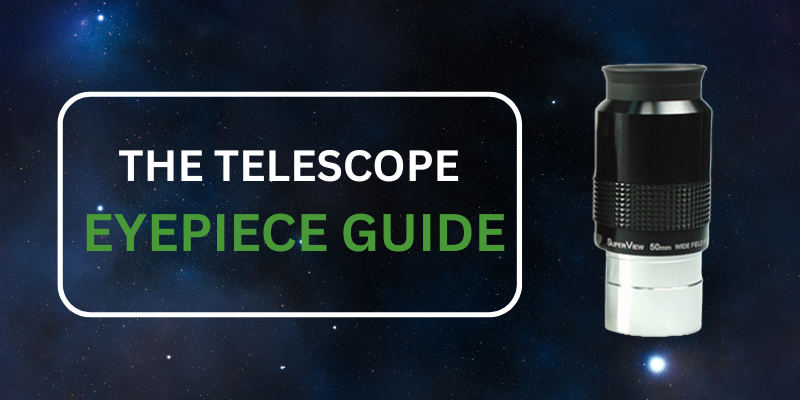
The eyepiece is the final gateway between your telescope and your eye and picking the right one can make a dramatic difference to what you see. Whether you’re viewing the Moon, planets or deep-sky objects, the right eyepiece will improve contrast, field of view and comfort. This guide will help you understand the key features of eyepieces, how to choose them for your telescope, and how to build an effective set.
What to Consider When Choosing an Eyepiece
Focal length & magnification – The eyepiece focal length determines how much magnification you’ll get when used with your telescope’s focal length.
Apparent & true field of view – A wider apparent field gives a more immersive view, while the true field depends on your magnification and eyepiece field angle.
Barrel size – Most eyepieces come in 1.25″ or 2″ barrel sizes; larger barrels often give wider fields but require compatible focusers.
Eye relief – Especially important if you wear glasses: the distance your eye can be from the eyepiece and still see the whole field matters for comfort.
Optical design & quality – Designs like Plössl, Orthoscopic, Ultra-Wide have different trade-offs in field size, sharpness and price.
Types of Eyepieces & When to Use Them
Long-focal-length eyepieces / low magnification: Great for wide-field views like star clusters, Milky Way panoramas.
Medium-focal-length eyepieces: A good “all-rounder” for lunar, planetary and many deep-sky objects.
Short-focal-length eyepieces / high magnification: Useful for lunar detail, planets; but require good seeing and stable mount.
Zoom eyepieces: Versatile single unit covering multiple focal lengths; good for travel or limited gear, though some compromise on optical performance.
Building a Balanced Eyepiece Set
A simple effective approach:
- One wide-field low-magnification eyepiece for locating targets and big vistas.
- One mid-magnification eyepiece for general viewing.
- One high-magnification eyepiece for detail work (planets, lunar).
This gives flexibility without overwhelming investment.
How to Get the Most Out of Your Eyepieces
- Know your telescope’s focal length: magnification = telescope focal length ÷ eyepiece focal length.
- Choose eyepieces that match your observing goals (wide-field, detail, travel setups).
- Ensure your focuser and mount are stable and well-aligned – even a great eyepiece can’t compensate for shaky optics.
- If you wear glasses, prioritize eyepieces with generous eye relief.
- Start with a modest magnification to locate objects, then switch to higher magnification once centered and stable.